In the words of Rev. Jesse Jackson, poverty is bad for your health. I sat in an audience at a recently concluded "State Of The Black Family" summit, organized by The Word Network, and hosted by Greater Grace Temple of Detroit, MI. A panel including Rev. Jackson discussed the state of the black family in America today. The aim of the summit was to highlight issues facing the African American family and what remedies can be applied. I was intrigued at the information presented to the audience. Knowledge is power and if we are to remove ourselves from the bondage of poverty then we must empower and arm ourselves with information. We are all aware of diseases affecting our population.
What we might not have internalized is the extent to which poverty impacts diseases. For example, a person living in an inner city community without reliable transportation has very little options in order to maintain a diet that is healthy and supportive of his wellness goals. The store on the corner is less inclined to carry times such as fresh fruit and vegetables but is armed to the teeth with alcohol, canned goods, foods high in sodium,and low in nutrition. Poverty is bad for your health. Poverty is also a vicious cycle as it afflicts generation after generation of individuals who exist on the edges of society who never have enough to maintain their current situation or to allow for economic empowerment of the next generation.
How do we stop this vicious cycle from afflicting our population? We need programs that offer support and and educational investment among youth of inner city populations.There has to be some community regeneration projects with the underlying intention of making each community economically empowered. Read more: http://harrietcammock.blogspot.com/2011/09/poverty-is-bad-for-your-health.html?spref=bl
Affichage des articles dont le libellé est inner city communities. Afficher tous les articles
Affichage des articles dont le libellé est inner city communities. Afficher tous les articles
lundi 12 septembre 2011

vendredi 9 septembre 2011
Former U.S. Lawmaker Kwesi Mfume Says Poor & Minorities Will Benefit from Expanded Broadband & Tele-Health Advances in U.S.
Former U.S. lawmaker Kwesi Mfume says poor and minorities will especially benefit from expanded broadband and tele-health advances.
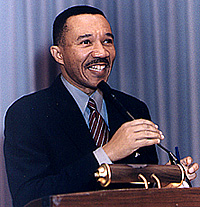 |
| Kwesi Mfume (Wikipedia) |
When we think of the technological advances of the past 20 years, one in particular will probably come to mind for most Americans: wireless technology, which now enables us to access the Internet from anywhere. But when most Americans think of the top uses for the wireless Internet, health care is probably not the first thing on that list. Perhaps, in the near future, it will be.We will continue to feature African American leaders making a difference in the push to get more broadband Internet access to the underserved, including the poor and minorities, in our country. As you can see, the Internet and emerging technology are changing the way we live and conduct our every day lives. Tell a friend about the wonderful things Kwesi Mfume, Jamal Simmons and others are doing.
The current revolution in medicine will use the full potential of technology to transform medical practice to save lives and improve health. Tele-health — the delivery of health-related services and information via telecommunications technologies — not only enhances efficiency, care and affordability, but it holds the key to profound improvements in medical treatment by eliminating physical barriers to high-quality health services.
Thanks to broadband, a primary care doctor can now digitally transmit images to a specialist across the country or even across the globe with the click of a button. And imagine the convenience of digital consultations with a physician while still in your home, with secure, remote access to medical records that span the entirety of one's medical history. Imagine, too, how many lives will be saved when doctors can connect, real-time via video feed, for surgical or medical procedures, with no barriers and physical constraints.
These applications will have the power to improve the lives of those struggling with medical issues that formerly required frequent trips to the hospital and sometimes surgeries or other risky procedures. Further, they will enable earlier detection and more effective treatment of critical health problems through remote monitoring.
These advances are particularly important when we consider that 49 percent of Americans have at least one chronic disease and that for many diseases the impact increasingly falls along racial and ethnic lines. Peer-reviewed studies and government data indicate that racial and ethnic minorities are burdened with a higher prevalence of chronic diseases. Imagine, then, the potential of telemedicine to serve as a lifeline to the African-American community.
Read the entire article: http://www.baltimoresun.com/news/opinion/oped/bs-ed-broadband-20110815,0,1530397.story
dimanche 2 août 2009
Sears Tower Renamed Willis Tower, Recalls Ugly Era of Segregation in Chicago Schools at the Hands of Benjamin Coppage Willis, School Superintendent
 Chicago's Sears Tower, the tallest building in North America, has been renamed the Willis Tower, the name is a stark reminder of a period of hatred and segregation in the United States. The name reminds many Chicagoans of Benjamin Coppage Willis, Superintendent of Schools in Chicago in the 1960s, who was accused of perpetuating racial segregation by refusing to move black children into white schools. He died on Saturday in his home, ironically in a placed called Plantation, Fla., and was 86 years old. Willis presided over the schools during an ugly time in the city's history and in the era of court-ordered desegregation after the Supreme Court's decision in Brown v. Board of Education in 1954 and the passage of the Civil Rights Act 10 years later. Willis' critics have accused him of deliberately keeping black children at overcrowded schools in the inner city, while there were many available spaces in white neighborhoods, in short, black segregation.
To many civil rights leaders, who led protests against Mr. Willis from 1963 to 1965, his 13-year tenure as superintendent was symbolized by the 625 mobile classrooms he established to alleviate overcrowding at mostly black schools on Chicago's South Side. The critics called the mobile classrooms ''Willis Wagons.''Benjamin C. Willis may have been revered in certain quarters, but he was a vile reminder of the scourge of segregation and racism in this country. Though the name of the Willis Tower, named after Willis Group Holdings, has nothing to do with him, the name is a stark reminder of the racial turmoil that existed in the United States during that dark period. It should also serve as a motivator for our young black men and women to reach for the stars, get a solid education and give back to your society because so many blacks fought and died for us to be treated with respect and not discriminated against.
Benjamin Coppage Willis was born on Dec. 23, 1901, in Baltimore. He received his doctorate from Columbia University and, after starting as principal of a four-room schoolhouse in Henderson, Md., eventually became superintendent of the school systems in Hagerstown, Md., Yonkers and Buffalo. Drew Praise at First
He was appointed to the Chicago post in 1953. Forceful and confident, described in one new account as confronting ''each hour as another landing on Guadalcanal,'' Mr. Willis drew praise in the 1950's for cutting class size, streamlining construction of new school buildings, and working out higher salaries for teachers.
But in 1963, protests broke out when civil rights leaders and black students accused Mr. Willis's administration of fostering segregation in the schools. Protesters burned mobile classrooms, boycotted classes, went on hunger strikes and picketed Mr. Willis's home. The Rev. Dr. Martin Luther King Jr. led some of the protests against Mr. Willis. At the 1963 march on Washington, 3,000 Chicagoans strode down Pennsylvania Avenue, chanting ''Down with Willis.''
For three stormy years rife with similar upheavals, Mr. Willis kept his post, finally leaving in 1966, four months before his term was to end. After leaving Chicago, Mr. Willis worked for two years as schools superintendent in Broward County, Fla.. He retired in 1972. Source: NY Times
To read more about Benjamin C. Willis, CLICK HERE.
mercredi 17 juin 2009
Nearly 60% Won't Graduate At Chicago Southside's Myra Bradwell Elementary, Some Parents Such as Tatianna Dennis Blame the School for her Son's Failure
 Chicago Public Schools are in the news again and this time the reports are pretty damning. Apparently CBS2's Jim Williams reported that 44 out of 77 students flunked the eighth grade at Myra Bradwell Elementary School. Not only have these students fallen through the cracks by the school system, their parents failed them as well. The finger-pointing has begun, with some parents saying it's the school's fault, while others say it's the fault of the parents. In poor communities, the school administration is usually the scapegoat, with the parents removing themselves from the equation. What I find utterly preposterous is that Tatianna Denis, the mother of Tarrell Dennis, who failed the eighth grade, said in an interview with CBS2 that she "got no warning her son was struggling. The school said she was notified, and other parents insist she did not do enough. Tatianna Dennis' son, Tarrell, took his eighth grade photo complete with cap and gown, but the day before his grammar school's graduation, Tarrell learned he would not be marching down the aisle."
Wait, hasn't it ever occurred to her that she could have checked his grades or even attended a parent-teacher meeting during the course of the year? Surely there were signs that this kid was flunking out of school and she would have seen them if she took the time to look. So, blaming the school is utterly ridiculous on so many levels. The problem is this woman works at nights as a security guard, how in the world can she monitor what her child is doing at night. This leads me to another question, who is the other authority figure in the home when she's not there? A father? Or the kid taking care of himself? It's time for these black fathers to play their roles and stop being sperm donors and being transient or nonexistent in the lives of their kids. The problem most of these kids are facing started in their homes, not in the schools.
It was a disastrous year for the eighth grade at the south side Bradwell Elementary school in a tough neighborhood with high poverty. More than half the class, 44 of 77 students, did not graduate. Loetisis Billingsley's nephew is one of those failing students. "It's horrible because these kids were under the impression they were graduating, and they let them know at the last minute that they wasn't," Billingsley said.As a parent, I keep in close contact with my children's teachers. The school as an Internet function that allows me to see my children's grades and their attendance, so anything that doesn't seem right, I can address immediately. Ms. Dennis should be ashamed of pointing a finger at the school's limitations rather than looking at her own failure to monitor her child's progress in school. Stop blaming the schools, start being a better parent! One thing I will concede, that had this been a school in the suburbs, the school would have been a lot more proactive in stemming this trend and the parents would have been much more involved in the lives of their children.
The Board of Education insists the Bradwell school did everything possible to keep the students' grades up, offering extra credit and school on Saturday. And the Board says written notices did go out. Some parents came to the defense of the school. "You have to be in your kid's life, you have to know what's going on in their world," said parent Vanessa Ewing. "I'm up at the school. The teachers know me. I stay on them. I stay on my kids.""It was something that child must not have been doing right in order for him to stay behind," said parent Sharon Shavers.
Tatianna Dennis' son is now in summer school. She works nights as a security guard, leaving her little time with Tarrell to supervise his homework. "Especially now, when I need the help the most, with situations like this," Dennis said. "And there's nobody but me. But I get through it." On an encouraging note, Dennis says her son is so upset he failed eighth grade, he is now determined to be a better student, pass his classes this summer and go on to high school. In that south side neighborhood, another mother said she has all the cell phone numbers of her kids' teachers and she calls them all the time, and her kids are doing well in school. Source: CBS2 News
Inscription à :
Articles (Atom)