Former U.S. lawmaker Kwesi Mfume says poor and minorities will especially benefit from expanded broadband and tele-health advances.
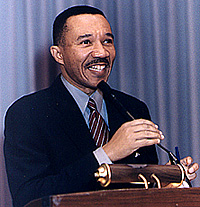 |
| Kwesi Mfume (Wikipedia) |
When we think of the technological advances of the past 20 years, one in particular will probably come to mind for most Americans: wireless technology, which now enables us to access the Internet from anywhere. But when most Americans think of the top uses for the wireless Internet, health care is probably not the first thing on that list. Perhaps, in the near future, it will be.We will continue to feature African American leaders making a difference in the push to get more broadband Internet access to the underserved, including the poor and minorities, in our country. As you can see, the Internet and emerging technology are changing the way we live and conduct our every day lives. Tell a friend about the wonderful things Kwesi Mfume, Jamal Simmons and others are doing.
The current revolution in medicine will use the full potential of technology to transform medical practice to save lives and improve health. Tele-health — the delivery of health-related services and information via telecommunications technologies — not only enhances efficiency, care and affordability, but it holds the key to profound improvements in medical treatment by eliminating physical barriers to high-quality health services.
Thanks to broadband, a primary care doctor can now digitally transmit images to a specialist across the country or even across the globe with the click of a button. And imagine the convenience of digital consultations with a physician while still in your home, with secure, remote access to medical records that span the entirety of one's medical history. Imagine, too, how many lives will be saved when doctors can connect, real-time via video feed, for surgical or medical procedures, with no barriers and physical constraints.
These applications will have the power to improve the lives of those struggling with medical issues that formerly required frequent trips to the hospital and sometimes surgeries or other risky procedures. Further, they will enable earlier detection and more effective treatment of critical health problems through remote monitoring.
These advances are particularly important when we consider that 49 percent of Americans have at least one chronic disease and that for many diseases the impact increasingly falls along racial and ethnic lines. Peer-reviewed studies and government data indicate that racial and ethnic minorities are burdened with a higher prevalence of chronic diseases. Imagine, then, the potential of telemedicine to serve as a lifeline to the African-American community.
Read the entire article: http://www.baltimoresun.com/news/opinion/oped/bs-ed-broadband-20110815,0,1530397.story

Aucun commentaire:
Enregistrer un commentaire